

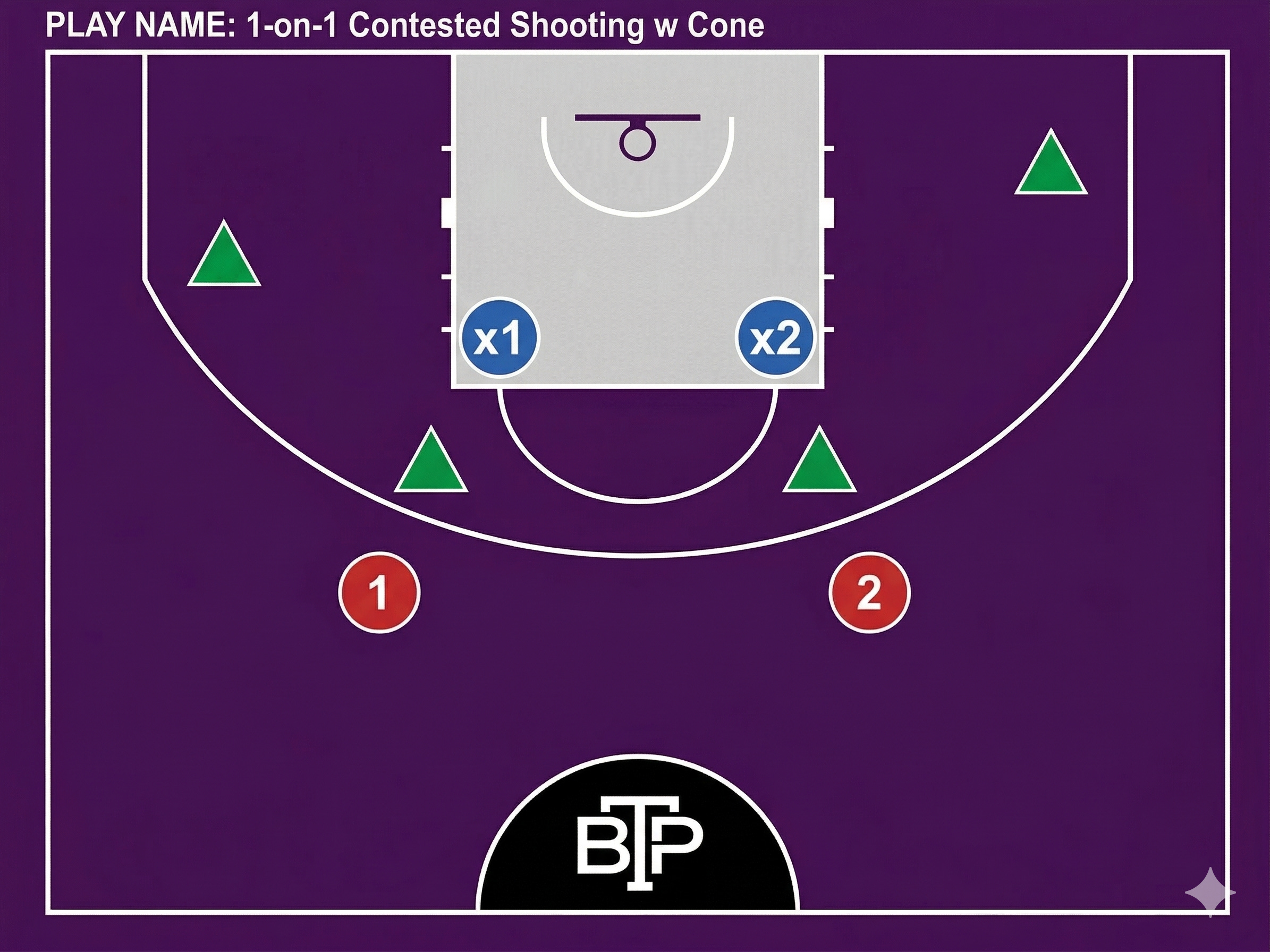
The Setup
1 Player will be on offense and the other player will be on defense.
Defense will start 3 steps back. They must touch the cone before contesting.
It is live when the offense get into their shooting motion.
1 point = 1 make.
Make it take it. First player to 3 points.
Constraint Ideas
When defense moves, it is live. (see video)
BRADs/Swishes = 2 points
Different ball start positions (see video)
Off the dribble (see video)
Co-design: players add a constraint to the game (see video)
Move the cone further away to give the shooter more time, or closer to increase the challenge point. (Camacho et al. (2020) found that time constraints and live defenders increase the “mental load,” which is exactly what drives adaptation. )
Purpose
Representative Learning Design (RLD)
With a live defender, it is easier to change the challenge point with simple constraint manipulations. This is one of NLP’s 5 principles: Task Simplification.
RLD is ensuring practice “looks, feels, and acts” like the game.
This is Representative Learning Design at its best. The shooter must perceive the speed and angle of the close-out. This develops Perception-Action Coupling. Coaches can even consider adding in points for defense: 1 point if the defense is able to block the shot.
Task Simplification: The process of simplifying (or adding complexity) the game to help learners be at the optimal challenge point.
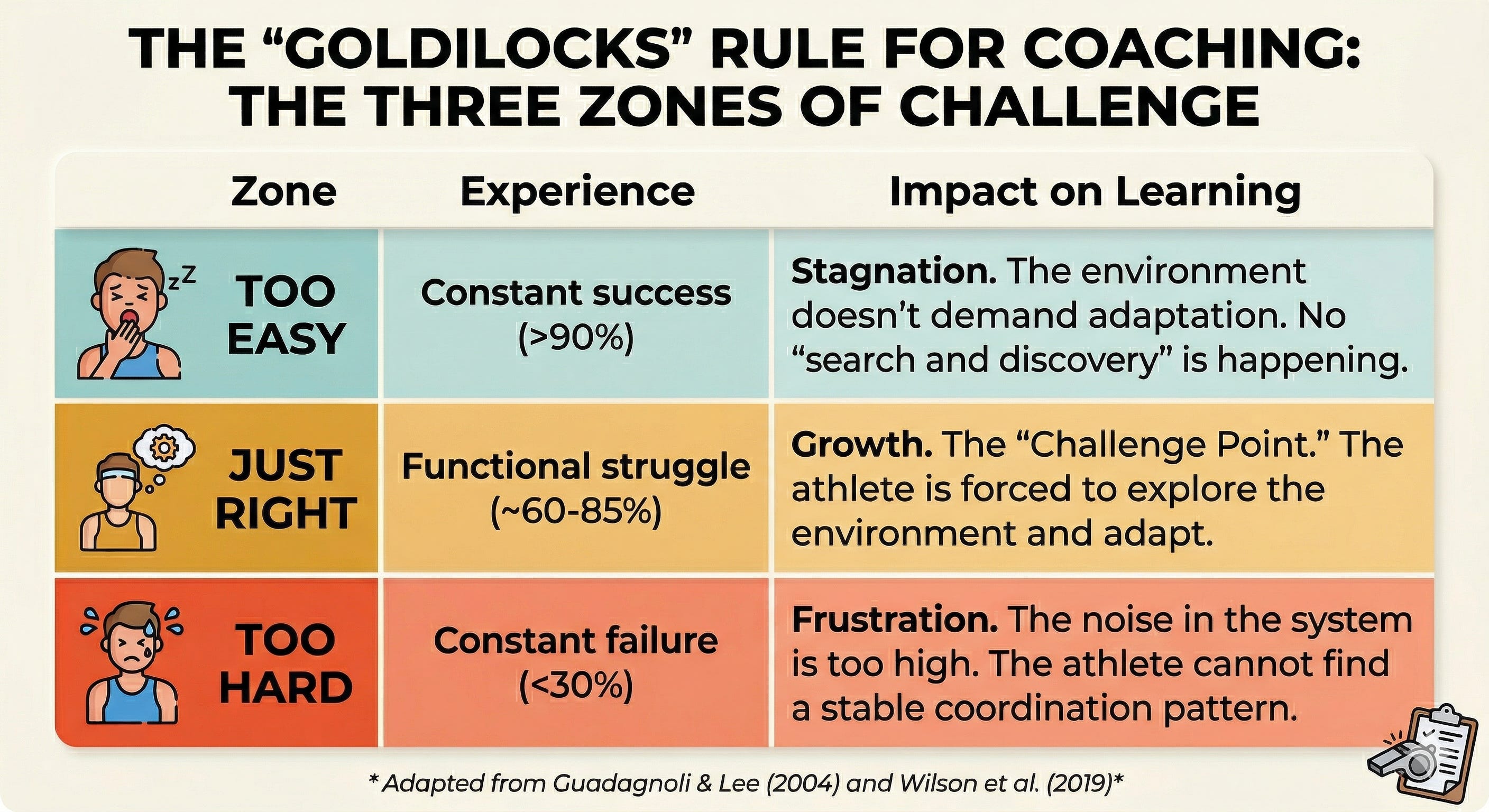
This framework provides the “Goldilocks” rule for coaching: learning is maximized when the task difficulty matches the player’s skill level. If it’s too easy, there is no information to process; if it’s too hard, the information is overwhelming. (Guadagnoli & Lee, 2004)
References:
Guadagnoli, M. A., & Lee, T. D. (2004). Challenge point: a framework for conceptualizing the effects of various practice conditions in motor learning. Journal of Motor Behavior, 36(2), 212–224. https://doi.org/10.3200/JMBR.36.2.212-224
Pinder, R. A., Davids, K., Renshaw, I., & Araújo, D. (2011). Representative learning design and functionality of research and practice in sport. Journal of Sport and Exercise Psychology, 33(1), 146–155. https://doi.org/10.1123/jsep.33.1.146
Wilson, R. C., Shenhav, A., Straccia, M., & Cohen, J. D. (2019). The Eighty-Five Percent Rule for optimal learning. Nature Communications, 10(1), 4646. https://doi.org/10.1038/s41467-019-12552-4
Bjork, E. L., & Bjork, R. A. (2011). Making things hard on yourself, but in a good way: Creating desirable difficulties to enhance learning. [Read PDF via UCLA.edu]
Schmidt, R. A., & Bjork, R. A. (1992). New conceptualizations of practice: Common principles in three paradigms suggest new concepts for training. Psychological Science, 3(4), 207–217.


